
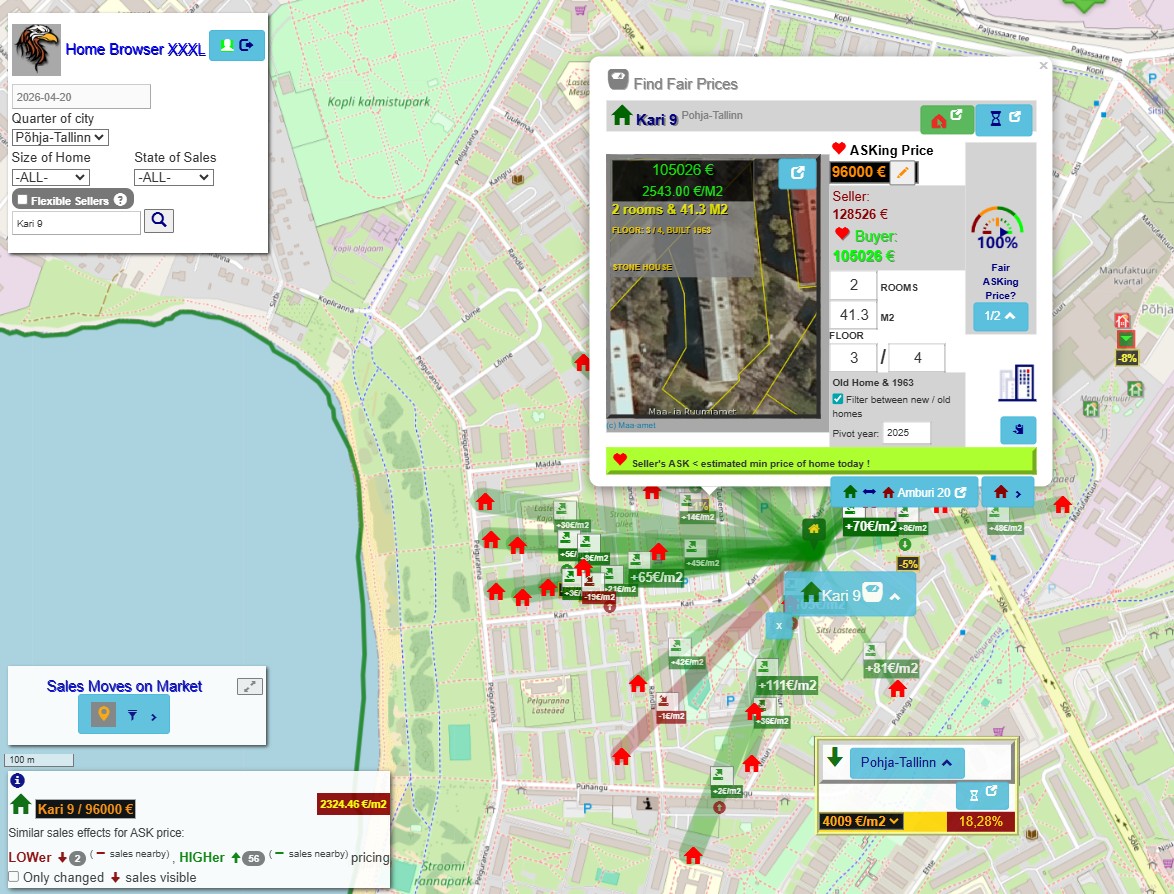
Both properties – Kari 9 and Amburi 20 – (built in the 1960s, small 2-room units) sit in the same general category: older apartments that investors typically target for value-add or rental yield. On the surface, they look comparable—but the pricing dynamics split them quickly.
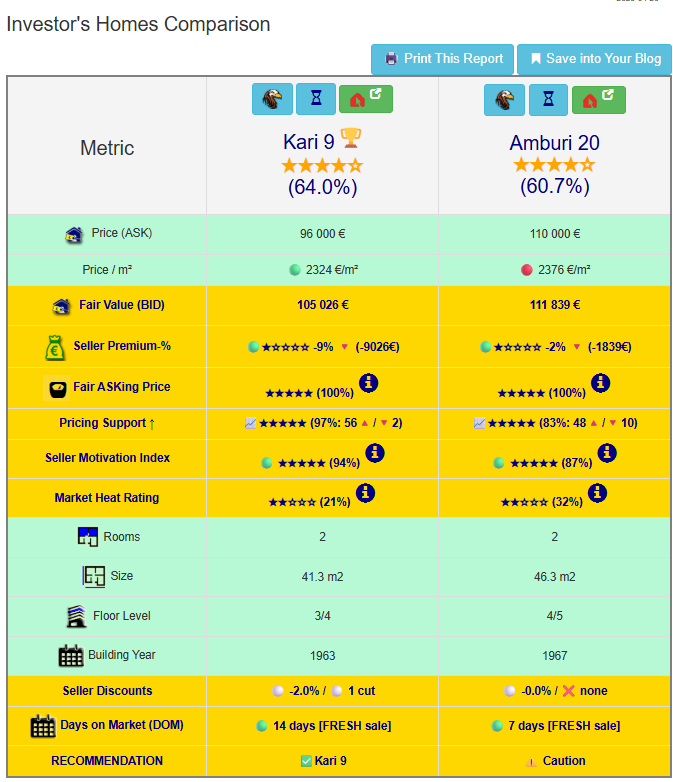
Kari 9: the mispriced opportunity
Kari 9 stands out as a classic “seller blink” situation.
- The asking price (€96k) is well below its estimated fair value (€105k)
- That’s a ~9% discount, which is unusually large for a fresh listing
- The system flags this with very strong pricing support (97%) and high seller motivation (94%)
What that means in plain terms:
The seller likely wants out quickly—maybe due to urgency, liquidity needs, or simply misjudging the market. The property hasn’t sat long (14 days), so this isn’t a stale listing—it’s underpriced right now.
For an investor, this is the kind of deal where:
- You don’t need to negotiate hard—the margin is already built in
- Your upside exists on day one, not just after renovation or rent optimization
- The main risk is competition once others notice
Amburi 20: the “looks fine, but no edge” deal
Amburi 20 is much closer to what the market expects—and that’s exactly the problem.
- Asking price (€110k) is only slightly below fair value (€111.8k)
- Seller discount is basically nonexistent (0%)
- Lower pricing support (83%) and weaker seller motivation (87%)
In other words:
This is a correctly priced property, not a strategically priced one.
For investors, that usually translates to:
- Limited immediate upside
- Returns depend heavily on execution (renovation, rent increases, market growth)
- Less negotiating leverage since the seller isn’t under pressure
Even though it sold faster (7 days), that speed likely reflects it being “acceptable” to the market—not a hidden gem.
Market temperature: lukewarm, not competitive
Both listings show relatively low market heat (21% vs 32%). That’s important.
This isn’t a bidding-war environment.
It’s a buyer’s market or at least a balanced one, where:
- Good deals exist—but you have to spot them
- Overpaying is easy if you don’t stay disciplined
The real takeaway: this is about margin vs. neutrality
- Kari 9 = built-in margin
You’re buying below value, with a motivated seller, in a calm market. That’s a strong combination. - Amburi 20 = fair deal, no cushion
You’re paying roughly what it’s worth and relying on future performance to justify the investment.
If this were a strategy call
An experienced investor would likely:
- Move quickly on Kari 9 before the pricing inefficiency corrects
- Either negotiate Amburi 20 down—or pass and wait for a better entry
Quick investor’s tip
Kari 9 is the better buy because you’re getting instant equity at purchase. It’s priced about 9% below fair value, with a highly motivated seller and strong pricing support—meaning the deal is already in your favor before you do anything.
Amburi 20, on the other hand, is basically fairly priced with no margin. You’d have to create all the upside yourself through renovation or market growth.
Bottom line
Kari 9 gives you a head start (built-in profit + negotiation leverage), while Amburi 20 gives you a neutral starting line.